10 Questions Muslim Teenagers Ask About Religion — And How to Answer Them
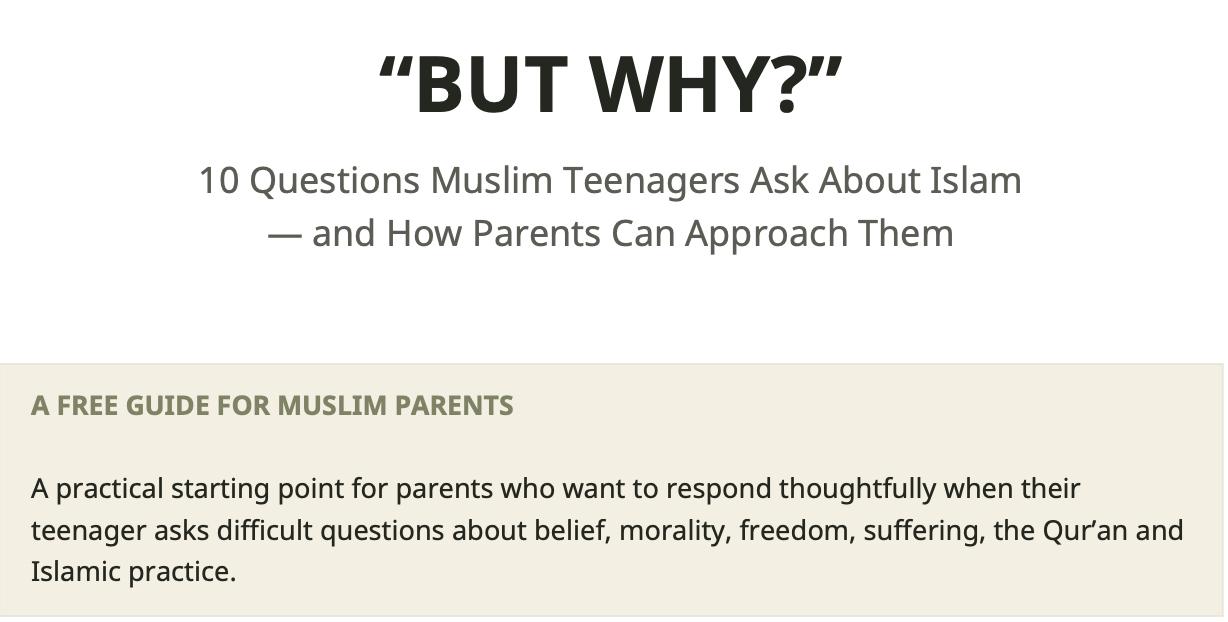
Your teenager may ask difficult questions about Allah, Islam, morality, freedom, suffering, the Qur'an or the purpose of life. This free guide gives parents a thoughtful starting point for understanding the question underneath the question — and having better conversations about faith.
Get the Free GuideA practical starting point — not a substitute for qualified scholarship.
Your teenager asking questions is not the problem.
Teenagers encounter questions about God, morality, freedom, suffering, relationships, identity, science, religion and purpose. Some questions may sound challenging. Some may even make a parent uncomfortable.
But a difficult question is not necessarily a rejection of Islam. Sometimes it is simply a young person trying to understand what they have been taught to believe.
The more useful question is not only: “How do I answer this?”
It is also: “What is my teenager actually trying to understand?”
Before giving an answer, learn to understand the question.
The guide is not designed to give parents ten memorised answers. It offers a framework for approaching difficult conversations with more patience, clarity and intellectual honesty.
Listen for the real question
What your teenager says may not be the whole question. Learn to notice what they may actually be trying to understand.
Understand before explaining
Slow the conversation down instead of immediately trying to defend or correct.
Have better conversations
Create an environment where honest questions can be explored without making the teenager afraid to ask.
Know when to investigate
Some questions require deeper study. The guide helps you recognise when it is time to investigate further.
Ten questions that can open much bigger conversations.
Each question is approached by looking at what may be underneath it, how a parent might begin the conversation, and relevant Islamic starting points for further reflection.
How do we know Allah actually exists?
Why should I believe Islam is true?
If I'm a good person, why do I need Islam?
Why does Islam have so many rules?
If Allah is good, why does He allow suffering?
How do we know the Qur'an is really from Allah?
Why can't I question Islam?
If Allah knows everything, do I really have free will?
Why do I have to pray if I already believe in Allah?
What is the point of my life?
Listen. Clarify. Investigate. Explain. Connect.
A parent does not need to win every conversation. The first task is often to understand the question accurately, slow the conversation down, and investigate it together.
The guide includes:
- 10 important questions Muslim teenagers may ask
- What may be underneath each question
- Islamic references and starting points for reflection
- A practical approach to difficult conversations
- Guidance for when you don't know the answer
Give yourself a starting point for the conversations.
Enter your details below and the guide will be available immediately after your submission.
You can use it as a starting point for conversations at home, or simply as a reminder that difficult questions do not have to become difficult relationships.
Get “But Why?”
Free guide for Muslim parents.
“You don't need to have every answer to be a good parent. You need to make it safe for your teenager to keep asking good questions.”
And when you don't know, “I don't know. Let's find out” can be a much better answer than pretending to know.
Continue exploring.
The guide is one starting point. The Traditional Lens creates educational spaces for Muslims to explore Islam, human nature, modern life and the questions that shape them.
Values of Islam
A longer-form programme for teenagers exploring Islamic worldview, values and the assumptions shaping modern life.
Join the Waiting List →Workshops
Short online workshops exploring important questions about Islam, human nature, relationships and modern life.
Explore Workshops →Articles & Resources
Reflections, book reviews and audio resources exploring questions around Islam, modernity and meaningful living.
Explore Resources →