Give Your Teenager an Opportunity to Explore Why Islam Is Rationally Defensible
An online workshop introducing Muslim teenagers to rational frameworks for examining some of the foundational beliefs of Islam—and the assumptions behind contemporary criticisms of religion.
Online | Ages 13–22
16th & 19th September | 4:30–7:00 PM PKT

What Students Have Said About Learning With Us
These reflections come from students who previously took part in our Values of Islam programme.
“I got to understand the ‘what’, ‘why’ and ‘how’ behind things. I became aware of the Western perspective and the Islamic perspective, and realised how much the Western perspective had influenced me. […] Alhamdulillah, I gained clarity on many things.”
“One of my biggest misconceptions that was cleared was about the social order. […] When we discussed it in class, one point really stuck with me: a boy can’t tell his mother what to do simply because he is a male. […] This whole social order where guys are higher in the hierarchy is actually nowhere there.”
“I would recommend people to do this course because they can clear very big misconceptions.”
“Initially, I thought this course would be boring—that it would only tell us things about Islam. But I later realised that Islam wasn’t the only thing being discussed. We discussed capitalism, Western society, and many other things. I found the course interesting, and some of my questions were clarified after joining.”
What parents have noticed
“I heard some of the recordings and was amazed at why we adults never got to know these basics.”
“During my aalmiyat I was hoping for answers to so many questions in my mind. They never got answered, but in fact my questions kept increasing. Alhamdulillah a lot got answered in the recordings I heard.”
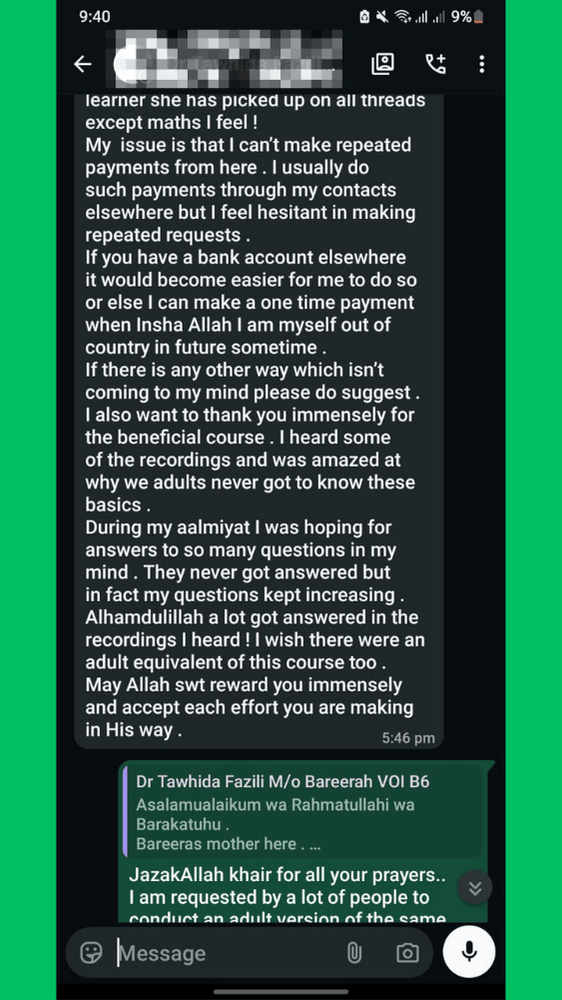
“Can she still be registered?”
A parent who had already enrolled one daughter for this workshop came back to ask about registering his other daughter as well:
“Can her registration still happen? … I’ll send you the payment as well, inshaAllah. Otherwise she’ll feel left out.”
Parent of a Values of Islam student
Interested in the Workshop?
See the full workshop outline, details, and registration options.
Online • Ages 13–22 • 2 sessions • Workshop material & certificate included

What Happens When Someone Asks, “But Why Is Islam True?”
Teenagers today encounter questions about Islam from friends, social media, classrooms and the wider culture around them.
Sometimes the questions are difficult. Sometimes the criticism comes wrapped in assumptions about freedom, autonomy, morality or what a rational person should believe.
And sometimes the discomfort doesn’t come from a lack of faith. It comes from simply never having had the opportunity to examine the foundations of that faith.
The aim is not to give teenagers a list of answers to memorise. It is to create an opportunity to explore the reasoning behind some of the foundational beliefs of Islam.
What Will We Actually Do in These Two Sessions?
The workshop begins with a simple question: What does it actually mean to call an argument “logical”?
From there, we will explore some of the assumptions that shape the way different worldviews reason about truth, knowledge, God, humanity and reality—and then use a rational framework to examine some of the foundational beliefs of Islam.
FRAMEWORK
What do we mean by logic and rationality? How can different systems of thought begin with different assumptions, while still appealing to rational reasoning?
FOUNDATIONS
We will explore rational arguments concerning Allah, Prophethood, the Qur’an and the Day of Judgment as foundational entry points into Islam.
BEYOND...
Once foundational beliefs are examined, we can begin to understand why some things may appear unreasonable when viewed through assumptions that come from a different worldview.
Disclaimer
This is a taste of a much larger subject.
Rational inquiry and Islamic theology are subjects that can be studied for years. Two sessions of 2.5 hours cannot possibly cover every philosophical question or objection.
The aim is therefore not to provide an exhaustive treatment, but to introduce a few foundational frameworks and give teenagers an opportunity to experience how they can be applied.
REGISTER NOW
What Will We Explore?
Across the two sessions, we will use selected questions and arguments to explore how rational inquiry can be applied to some of the foundations of Islamic belief.
What Is Logic?
What does it actually mean for something to be “logical”? We will examine how assumptions, definitions and starting points can shape the way we reason.
Does God Exist?
What does it actually mean for something to be “logical”? We will examine how assumptions, definitions and starting points can shape the way we reason.
Why Believe in Prophethood?
What does it actually mean for something to be “logical”? We will examine how assumptions, definitions and starting points can shape the way we reason.
Why Believe the Qur'an Is From God?
What does it actually mean for something to be “logical”? We will examine how assumptions, definitions and starting points can shape the way we reason.
Why Is There a Day of Judgment?
What does it actually mean for something to be “logical”? We will examine how assumptions, definitions and starting points can shape the way we reason.
Where Does Logic End?
What does it actually mean for something to be “logical”? We will examine how assumptions, definitions and starting points can shape the way we reason.
Not Just Answers. A Way of Thinking.
When a criticism of Islam appears convincing, the important question is not always “What is the Islamic answer to this?”
Sometimes the more fundamental question is: “What assumptions is this criticism built upon?”
Examine the Assumptions
Before accepting or rejecting an argument, we can ask what it assumes about God, humanity, freedom, knowledge, morality or reality.
Follow the Reasoning
Rather than relying on slogans or memorised responses, we will try to trace an argument to its foundations and examine whether its conclusions actually follow.
Understand the Foundations
If foundational beliefs are established through sound reasoning and reliable sources, they provide a basis from which other questions about Islam can be approached.
The aim is not to train teenagers to win arguments. It is to give them an opportunity to become more thoughtful about the arguments they encounter—and about the foundations of what they themselves believe.
Is This Workshop For You?
Perhaps you have encountered some of these questions yourself—or perhaps you simply want to explore the foundations of your beliefs more seriously.
When Someone Asks You Why
“But why do you believe Islam is true?”
If questions like this have ever made you realise that knowing what you believe is not always the same as knowing why, this workshop may be worth exploring.
When Another Worldview Sounds Convincing
Ideas about freedom, autonomy, morality, science, religion and human nature can sometimes seem self-evidently true because of the assumptions we are already accustomed to.
This workshop creates space to examine some of those assumptions.
When You Simply Want to Understand More
You don’t need to be struggling with doubt to ask deeper questions.
Sometimes the best time to explore the foundations of a belief is before you are put under pressure to defend it.
This isn’t about assuming that every question is a problem. It’s about creating the opportunity to think seriously about the questions.
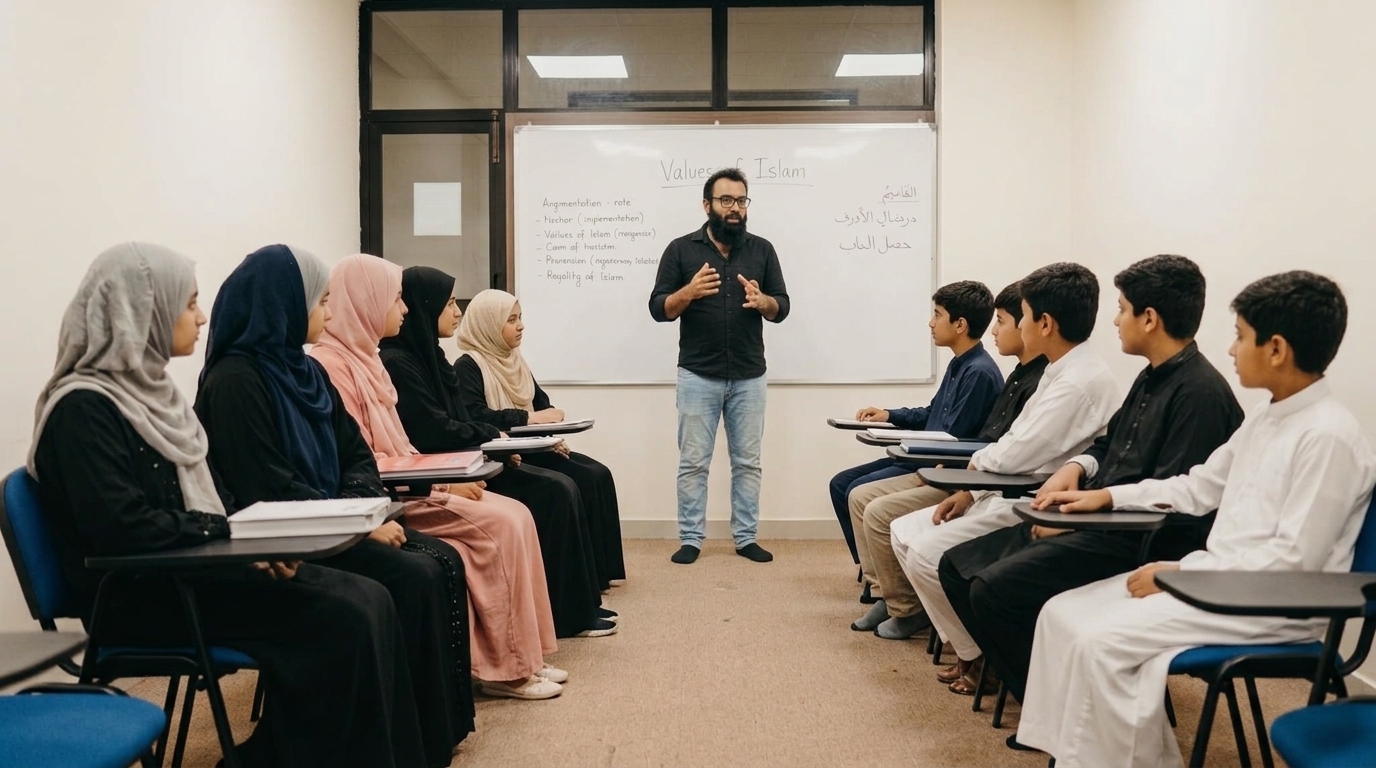
About the workshop facilitator
Sir Abdul Basit is an educator with 14 years of experience teaching O and A Level Mathematics, dedicated to helping students build academic clarity, discipline, and confidence. He completed the 9-year Dars-e-Nizami (Aalim) program, giving him a grounded understanding of Islamic studies, Quran, Hadith, Shariah, and Arabic. To further broaden his educational reach, he completed the PTCC program (Batch 56) and served as a co-mentor for Batches 59 and 61, while also studying Understanding Modernity and the Contemporary Age to analyze modern worldviews and their impact on identity and purpose.
Observing that many challenges faced by young Muslims stem from worldview rather than practical obstacles, he initiated conversations around these core perspectives. This grew into a successful 3-month online course run over five years, which officially organized under the banner of The Traditional Lens. Following the completion of its largest cohort to date, Sir Abdul Basit now conducts short workshops and seminars designed to keep students engaged with these meaningful concepts and welcome new teens into the community.
Workshop Details
Everything you need to know before registering.
DATES
16th & 19th September 2026
TIME
4:30 PM – 7:00 PM PKT
FORMAT
Online
AGE GROUP
13 – 22 years
DURATION
2 sessions • 2.5 hours each
FEE
PKR 4,500
Registration includes
✓ Both live sessions
✓ Workshop material
✓ Certificate of participation
⚠️ Limited to 20 participants. Registration closes automatically once all 20 places are filled.
View Details for Enrollment
Special Registration Discounts
Some participants may be eligible for a discounted registration fee.
SIBLINGS
20% off
PKR 3,600
VALUES OF ISLAM ALUMNI
30% off
PKR 3,150
CHILD OF A PTCCIAN PARENT
25% off
PKR 3,375
PTCCIAN PARENT + VALUES OF ISLAM ALUMNI
40% off
PKR 2,700
“Discounts cannot be combined except for the PTCCian parent + Values of Islam alumni category shown above.”
Only 20 Seats Available
places available for this workshop
Seats already taken
Seats remaining only
Registration will automatically close once all 20 places have been filled.
If the workshop reaches capacity, the registration form will stop accepting new responses. You can still stay connected for announcements about future workshops and activities.
Frequently Asked Questions
A few common questions before you register.
1. Who is this workshop for?
The workshop is designed for Muslim teenagers and young adults aged 13–22 who want to explore the reasoning behind some of the foundational beliefs of Islam.
2. Does someone need to be struggling with their faith to attend?
No. You do not need to be experiencing doubt or a particular problem with your faith. The workshop is also for those who simply want to understand the foundations of what they believe more deeply.
3. Is this a debate or argument-training workshop?
No. The aim is not to train participants to win arguments or memorise responses to objections. We will focus on examining assumptions, following reasoning and exploring selected foundations of Islamic belief.
4. Will the workshop cover every argument for Islam?
No. Rational inquiry and Islamic theology are much larger subjects than can be covered in two sessions. This workshop offers an introduction to selected frameworks and arguments, rather than an exhaustive treatment of every philosophical question.
5. What does the registration fee include?
The PKR 4,500 registration fee includes both live sessions, workshop material and a certificate of participation. Eligible participants may register at one of the discounted rates listed above.
6. What happens if all 20 seats are filled?
Registration will automatically close once all 20 places have been filled. If the workshop reaches capacity, you can still stay connected for announcements about future workshops and activities.
Give Them the Opportunity to Explore.
Questions about Islam are not going away. Creating the opportunity to examine them thoughtfully can be a valuable part of building a stronger foundation of belief.
Join the “Logical Reasons to Believe in Islam” workshop and explore some of the reasoning behind the foundations of Islamic belief.
Online | Ages 13–22
16th & 19th September | 4:30–7:00 PKT
Only 20 seats available. Registration closes automatically when all places are filled.