
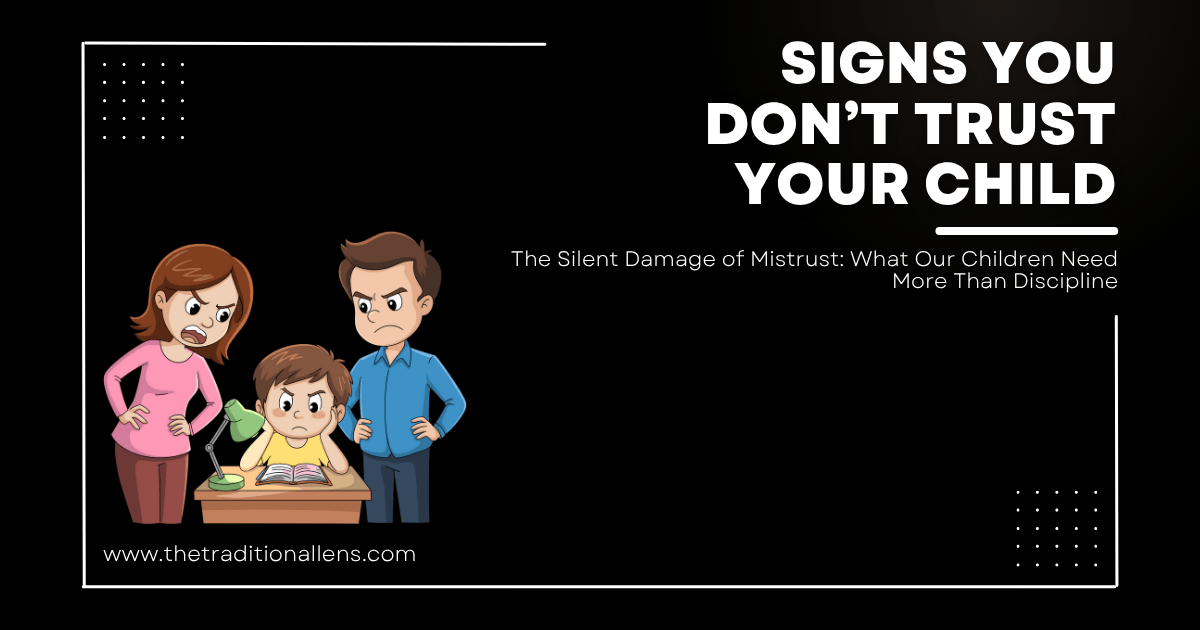
The Silent Damage of Mistrust: What Our Children Need More Than Discipline
As a young father, I often catch myself observing other parents — especially those who are further along in the journey. I listen closely to how they speak to their children, what worries they carry, and what patterns repeat across families. Something I’ve come to notice — and fear falling into myself — is the subtle but powerful habit of mistrusting our children. Not mistrust in the criminal sense, but mistrust in their nature, their intentions, and their potential to grow.
I recently watched a talk that stirred this realization even deeper. The speaker challenged something we don’t often admit: many of us don’t truly trust our children. We say we love them, care for them, want the best for them — but our tone, our words, our reactions often suggest something else.
Let me explain.
The Child’s Nature Is Not the Problem
One of the most harmful beliefs a parent can hold — even unknowingly — is that their child’s very nature is flawed. We say things like, “He’s always been stubborn, just like his uncle,” or “She’s got an angry temperament, it runs in the family.” These statements may seem harmless or even observational, but they quietly send a message: something is wrong with you at your core.
This is deeply misaligned with our Islamic understanding of human nature. Every child is born on a pure and good path — what we might call the “factory setting.” Just like a new phone, the default system is designed to work. But over time, “downloads” come in — negative influences, poor habits, unmet needs. These are the problems to be addressed — not the core system.
If I keep looking at my son and expecting him to be a troublemaker, he may slowly become one. But if I look at him with hope, with the expectation of goodness, I’m giving him something to rise toward. Our perception becomes their mirror — for better or worse.
Doubting Intentions: A Fast Track to Dishonesty
There’s a moment many parents know all too well — when a child does something wrong, and we say, “Just tell me the truth.” On the surface, it seems like a plea for honesty. But underneath, it often means: “I know you’re lying. Confess.” That presumption itself can be damaging.
Children, like adults, don’t always act with full awareness. Sometimes they lie out of fear. Sometimes they hide mistakes because they don’t feel safe being honest. When we say things like, “You are a liar,” we’re not correcting the action — we’re attacking the identity. That’s heavy for any heart, especially a child’s.
There’s a more compassionate and constructive way to respond. Instead of accusations, we can speak in a way that leaves room for dignity. Something like: “It seems like there might have been a misunderstanding here. Can we talk about it?” Or even, “Did something happen that made it hard to tell the truth?”
This shift — from blaming to exploring — tells the child: I still believe in you. I trust your heart, even if your behavior needs correction.
The Power of Language: Small Shifts, Big Impact
Even when correcting small issues, like a child missing a prayer, our words matter. Saying, “You left the prayer,” assumes it was intentional and careless. But saying, “It seems like the prayer was missed,” leaves room for understanding — maybe they forgot, maybe they were overwhelmed, maybe they didn’t know how to ask for help.
In a culture that’s often harsh and hurried, choosing words that preserve a child’s dignity is not weakness. It’s prophetic wisdom. The Prophet ﷺ corrected with gentleness, protected people’s honor, and always saw the potential for return.
A Lesson for Myself
As I write this, I think of my son, just one year old. Right now, he’s in that precious phase where everything he does amazes us — his laughter, his stubbornness, his energy. But I know a time will come when my patience is tested, when habits frustrate me, when my expectations grow heavier.
That’s when I’ll need this reminder the most.
Trusting our children doesn’t mean turning a blind eye to their mistakes. It means never giving up on their fitrah — their original goodness. It means correcting without crushing. It means speaking to their highest self, even when they’re at their lowest.
And ultimately, it means believing that Allah, who created them good, has given us the role to guide — not to label, control, or punish them into righteousness.
May Allah help me live up to that responsibility.
0 Comments