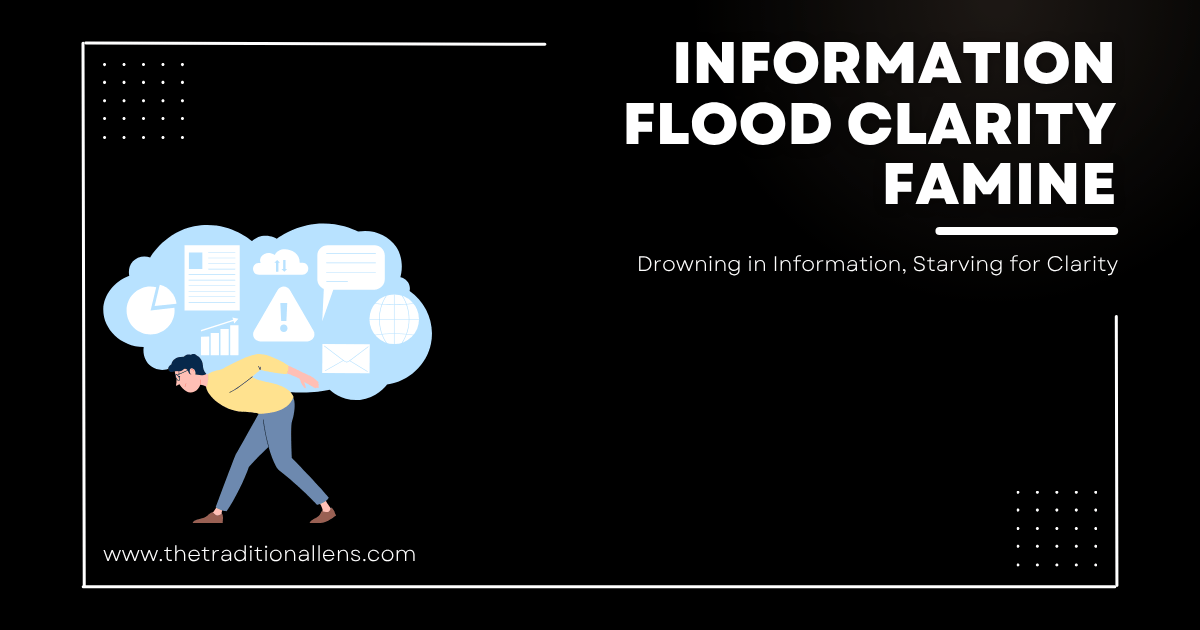
Drowning in Information, Starving for Clarity
The other day, I caught myself scrolling through a long thread of “insightful takes” on parenting, health, and spiritual growth — each one confidently claiming something contradictory to the last. After 15 minutes of reading, I felt more agitated than informed, and more confused than enlightened. It hit me: we live in an age where we know so much… and understand so little.
We often equate being “informed” with being “wise.” But having access to information is not the same as having clarity. That subtle difference is something I’ve been thinking about deeply, especially after reflecting on a talk about how the modern information influx has quietly eroded our ability to truly comprehend.
Information Has Lost Its Gatekeepers
There was a time when knowledge was pursued with humility — when one sat at the feet of teachers, asked fewer questions, and listened more. Today, all of us carry libraries in our pockets. With a few taps, I can explore Quranic tafsir, diagnose an illness, or analyze an economic theory — all without any real background or training.
At first glance, this seems empowering. But in reality, this abundance creates the illusion of competence. We’ve all met the “Google Doctor” or “YouTube Shaykh” — someone who confidently challenges experts with snippets they’ve picked up online. I worry, though, that I sometimes fall into that trap myself — reacting quickly, thinking I’ve understood, but in truth just skimming the surface.
We confuse access to information with internalization of knowledge.
When Information Blinds Instead of Illuminates
One of the most thought-provoking insights I encountered recently was a quote that roughly says: “Your light is concealed beneath the veil of awareness.” Meaning: too much awareness — when shallow and fragmented — can actually hide the truth rather than reveal it.
That’s the paradox of our times. In the past, a single idea could nourish someone’s heart and guide their life. Now, a dozen videos and books later, we often end up with only scattered thoughts, lost in a fog of conflicting narratives. We chase more, but understand less.
I’m reminded of a profound line of poetry that says something to the effect of, “Stop chasing knowledge, my friend — all you need is to understand one ‘Alif’.” Sometimes, understanding even one foundational truth — like who Allah is, what success truly means, or what your life is for — is more transformative than acquiring dozens of half-digested opinions.
Why Don’t We Dig Deeper Anymore?
Perhaps the most troubling part is how this information flood is reshaping our habits of thinking. We’ve become impatient. When something requires effort — a tough ayah, a difficult concept, a dense article — we often give up.
We want the thrill of knowing, without the labor of understanding.
But understanding requires sitting with an idea. Returning to it. Wrestling with it. Applying it. Living with it. And that process feels almost unnatural now in a world of swipes and skims.
Even in my own teaching of A Level Mathematics, I see it: students who want instant clarity, instant formulas, instant mastery. But mastery comes from struggle. So does clarity.
A Call to Simplicity and Depth
This realization leaves me with a deep conviction: I don’t need to know more. I need to understand better.
Whether it’s my relationship with my child, the structure of a math proof, or the pillars of my faith — I want to pause, slow down, and sit with truths long enough for them to reshape me from the inside out.
Clarity is not about collecting more dots. It’s about connecting the ones that matter.
May Allah protect us from the arrogance of shallow knowing, and guide us to the humility of deep understanding.
0 Comments